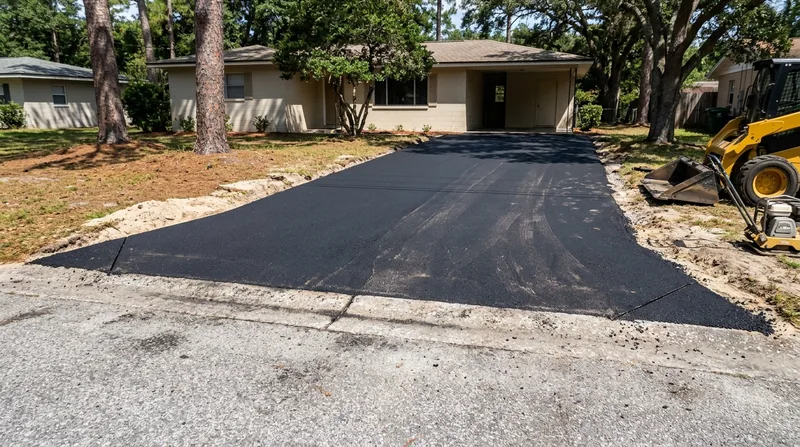




Driveway extensions, widening and aprons in Jacksonville tie new hot mix asphalt into old pavement right where your property meets the county right-of-way, or expand the width of a drive that's too narrow for modern vehicles. The challenge here is not the paving itself, but the grading and the joint. Jacksonville's flatwoods terrain and high water table mean that water pools against old asphalt edges if pitch and drainage are not managed precisely. We cut clean butt joints, grade for positive runoff away from structures, and match the slope of the extension to the existing drive so water sheds off instead of trapping against the old slab. Whether you need an apron at the street, a wider pull-off in a Riverside bungalow lot, or a turnaround in a Mandarin subdivision, the work demands site-specific grading and the right hot mix specification. We've been handling driveway extensions across Jacksonville, Orange Park, Fleming Island and St. Augustine since 2013.
Why Driveway Extensions and Aprons Matter in Jacksonville's Residential Landscape
Jacksonville's neighborhoods span from the tight in-town lots of Riverside and Avondale, where narrow driveways edged by century-old oak roots have no room to turn around, to the wider suburban blocks east of the river and on the Westside, to the newer subdivisions in Mandarin and St. Johns County where longer driveways cross open, flatter ground. Many of these properties were built before modern SUVs and trucks existed. A four-foot-wide drive that worked for a 1950s sedan does not work for a 2024 Tahoe. An apron at the street transition, where county right-of-way rules apply, must meet local grading and stormwater standards or it will fail within two seasons as water channels underneath it and the base erodes.
- An extension or apron widens the usable parking area without replacing the entire driveway, saving cost when the old asphalt is still sound.
- Proper grading and pitch prevent water from pooling against the old slab, where it will infiltrate the base and cause edge cracking and settlement.
- A clean butt joint between new and old asphalt, sealed and compacted correctly, prevents water from migrating along the seam.
- Aprons at the street must meet county curb-cut and stormwater rules, which vary from Jacksonville to Orange Park to St. Augustine, and permitting may be required.
- Extensions in master-planned communities may need HOA approval for material and slope before work begins.
Getting the extension right the first time prevents costly repairs later and ensures the new section bonds to the old without creating a trap for water or a weak point in the drive.
Key info: Jacksonville's Duval County and the cities within it (Jacksonville Beach, Atlantic Beach, Neptune Beach) each have different permitting rules for driveway aprons and right-of-way work. St. Johns County (St. Augustine, Nocatee, Fruit Cove) has its own standards. Before any grading or extension work, check with your local building department or HOA. We help you navigate those requirements, but the permit responsibility rests with the homeowner and the municipality.
For detailed information on permit requirements in your area, visit your city or county building department website to confirm what applies to your property.
How We Build Driveway Extensions and Aprons: The Jacksonville Method
A driveway extension or apron is not a simple pour-and-go job. The base must be compacted, the pitch must shed water away from the old pavement and toward drainage, and the new asphalt must bond to the old without creating a seam that will leak. In Jacksonville's sandy, high-water-table soil, a poor base is the fastest path to failure. We start with excavation and grading, prepare a proper aggregate base, proof-roll it for compaction, then lay hot mix asphalt in two courses (binder and surface) so the extension becomes part of the drive, not a patch that will separate in three years.
- We excavate to remove any soft or settled material and establish a stable subgrade for the new base.
- We compact an aggregate base (typically 4 to 6 inches) and proof-roll it to confirm bearing capacity and eliminate voids.
- We cut a clean butt joint along the edge of the existing asphalt, removing any loose or deteriorated material.
- We lay hot mix asphalt in two lifts, binder course first, then surface course, compacting each to specification.
- We grade the extension so water pitches away from both the old drive and toward the street or drainage swale.
- We verify that the extension matches or exceeds the slope of the existing drive so no water traps at the joint.
This method ensures the extension is not a temporary fix but a durable addition that will age with your driveway and handle Jacksonville's afternoon summer storms without pooling or erosion.
Local example: A Riverside homeowner with a 1920s bungalow and a four-foot-wide drive needed a six-foot widening to fit a modern truck. We excavated, set a 5-inch aggregate base, and laid 2.5 inches of hot mix asphalt. The extension pitched away from the old drive and toward the street. Total cost was $2,400. No apron permit was required in that zone, but we confirmed with the city before starting.
For more information on how we approach asphalt driveway paving and installation, see our main driveway service page.
Driveway Extension Methods and Materials
| Approach | Description | Best for |
|---|---|---|
| Hot Mix Asphalt Extension | Full-depth excavation, aggregate base, and two-course hot mix asphalt laid and compacted to specification. | Any driveway widening or apron where durability and integration with existing pavement is critical. Standard choice in Jacksonville. |
| Apron at Street Transition | Hot mix asphalt apron (typically 4 to 6 feet wide) at the property line, with curb cut and drainage swale per municipal code. | Properties where the drive meets the county right-of-way and a formal transition is required by local permitting. |
| Gravel or Recycled Millings Widening | Compacted recycled asphalt millings or quarry-run gravel alongside the existing asphalt drive, with grading for drainage. | Budget-conscious widening where the extension does not need to match the main drive surface, or rural properties with less traffic. |
| Overlay Extension | New hot mix asphalt laid over the existing drive edge and extended, without full-depth removal. Simpler grading. | Tight lots or where the existing base is sound. Not recommended if the old drive is already settling or alligatoring. |
Driveway Extensions, Widening and Aprons Cost in Jacksonville: What to Expect
Driveway extensions and aprons in Jacksonville typically start at $1,800 for a modest widening or apron on a standard residential drive, but cost varies with the size of the extension, the depth of excavation needed, the condition of the existing base, and whether permitting or curb cuts are involved. A 4-foot widening across a 20-foot-long drive (80 square feet of new asphalt) will cost less than a full-width 6-foot extension across a 40-foot drive (240 square feet). An apron at the street with a curb cut and stormwater compliance may require engineering or municipal inspection, adding cost. Tree roots, poor existing base, or settlement in the old drive will increase excavation and base-prep cost. We provide a written estimate with tonnage and thickness specifications so you know exactly what you are paying for before work starts.
For a full pricing overview and to understand what moves cost up or down, visit our pricing page. Every estimate is free and comes with no obligation to book. Call us at (904) 569-5441 for a same-day or next-day appointment.
What to Look for When Hiring an Asphalt Paving Contractor Near Jacksonville
Driveway extensions and aprons involve excavation, grading, and sometimes permitting. Hiring the right contractor means verifying that they understand local drainage and code, can provide a written estimate with tonnage and thickness, and will handle any required permits or HOA approvals. Avoid contractors who show up unsolicited, offer a price on the spot without measuring, or ask for a large cash deposit before starting work. Legitimate paving companies have a local address, local plates, and a track record you can verify.
- Ask the contractor to verify that they carry full insurance and request a certificate of insurance for your records.
- Get written estimates from at least two contractors, each with dimensions, tonnage, thickness, and materials specified.
- Check references from recent work in your neighborhood or a similar residential setting.
- If your property is in an HOA or a historic district, confirm that the contractor understands material and design approval before starting.
- Ask whether the contractor will handle permitting or coordinate with the building department, or whether that responsibility falls to you.
- Verify that the estimate includes grading, base preparation, and the butt joint detail, not just the asphalt cost.
Jacksonville Asphalt Paving has been serving residential and commercial properties across Greater Jacksonville since 2013. We are fully insured, provide free estimates with no obligation, and help homeowners navigate local permitting and HOA requirements. Call us at (904) 569-5441 or contact us online for a consultation.
Driveway Extensions, Widening & Aprons in Jacksonville: Pricing Guide
| Service | Price | Details |
|---|---|---|
| Small apron or extension (under 100 sq ft) | Starting at $1,800 | Includes excavation, aggregate base, two-course hot mix asphalt, grading for runoff, and clean butt joint detail |
| Medium widening (100 to 250 sq ft) | Starting at $2,800 | Larger footprint with extended excavation and base prep; cost per square foot decreases as area grows |
| Full-width apron or complex grading | Starting at $4,200 | Includes curb cut, stormwater swale, municipal inspection, or integration with settlement areas and tree roots |
| Recycled millings or gravel widening | Starting at $800 | Budget alternative for non-asphalt extension; includes excavation, compacted recycled asphalt or gravel, and grading |
| Estimate | Free | Response within 24 hours at (904) 569-5441, no obligation to book, written quote with tonnage and thickness |
Indicative pricing, the exact cost depends on square footage, finish, and site access. Free personalized estimate within 24h at (904) 569-5441.


