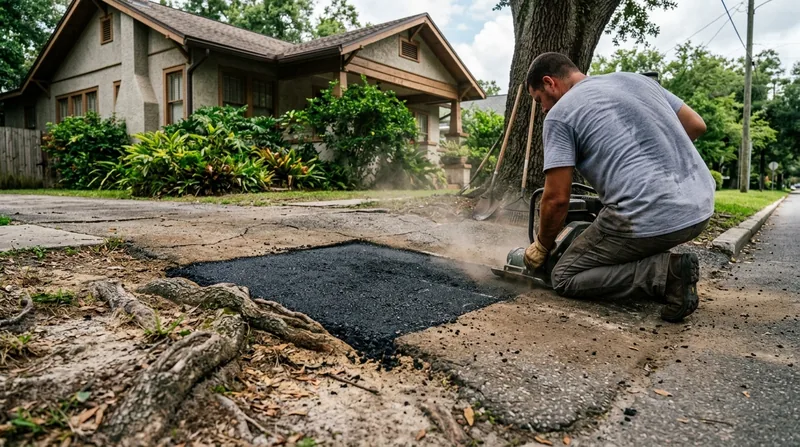




Jacksonville driveways crack and settle where the hardpan traps water under a base that looks dry on top. The pine flatwoods sand that underlies nearly every residential lot in Jacksonville, Orange Park, and St. Augustine sits just a foot or two above a dense clay hardpan that holds moisture even when afternoon summer storms drain off the surface. That water weakens the base, edges break away on sand that has no natural confinement, and oak roots in older neighborhoods like Riverside and Avondale lift slabs from below over years. Driveway repair in Jacksonville means cutting out the failed section, rebuilding the base properly so water drains through it, and patching with hot mix asphalt so the repair holds through the next tropical storm season and beyond. We've been doing this work since 2013 across Greater Jacksonville, and we know exactly what fails and why.
Why Jacksonville Driveways Fail: Understanding the Local Terrain
Jacksonville sits on sandy soil over hardpan, and that combination is the reason most driveways here develop cracks, settle unevenly, and break apart at the edges. The water table stays high, especially after the heavy afternoon storms that roll across Duval and St. Johns County from June through September. A driveway that looks solid on top can be failing underneath because the base has become saturated and lost its load-bearing strength. Grading matters as much as the mix itself, because water that pools or drains sideways into the subgrade will eventually lift and crack the asphalt above it.
- We remove the failed section of asphalt down to the subgrade, exposing the damage to the base.
- We rebuild the base with properly compacted aggregate so water can drain through it instead of pooling.
- We grade the repair area so surface water sheds away from the driveway and toward the street or drainage.
- We compact the new base with a proof roller to ensure it will hold under traffic and seasonal water pressure.
- We patch with hot mix asphalt, matching the thickness and compaction of the existing driveway.
This approach holds because we address the cause, not just the symptom. A patch that sits on a wet or uncompacted base will fail again in a year or two.
Key info: Jacksonville's high water table and summer storm season mean that base preparation is the difference between a repair that holds and one that fails. We proof-roll every base and verify compaction before we lay asphalt.
For more information on how we handle larger repair projects, see our page on pothole repair and asphalt patching.
How We Repair Your Driveway: Step-by-Step Process
A solid repair starts with cutting out the right amount of damaged asphalt and base. Too small a cut leaves soft material at the edges, and the repair will fail at the boundary. Too large a cut wastes money on material and labor. We measure the crack, assess how far the damage extends below the surface, and make the cut so the repair will hold. In neighborhoods like Mandarin and the Southside where driveways sit on flatter, more open ground, we have room to work. In tight in-town lots in San Marco and Avondale where oak roots and narrow aprons create confined spaces, we adjust our approach and often use smaller, strategic patches.
- We inspect the failed area and take depth measurements to determine how much base has been compromised.
- We cut the asphalt in a clean geometric shape, usually rectangular, so the repair edges are stable.
- We haul away the cut asphalt and damaged base material.
- We bring in new aggregate base and compact it in lifts with a plate compactor or roller.
- We grade the base so water will drain through it and away from the driveway.
- We proof-roll the compacted base to confirm it will support the asphalt and traffic.
- We lay hot mix asphalt to the same thickness as the surrounding driveway and compact it thoroughly.
- We allow the patch to cure before you drive on it, typically 24 to 48 hours depending on weather.
The entire process, from cut to compacted patch, usually takes one to two days for a typical residential repair.
Example: A homeowner in Jacksonville Beach noticed a two-foot-wide crack running across the middle of the driveway apron where water was pooling after rain. We cut out a four-by-six-foot section, rebuilt the base with two inches of compacted aggregate, and patched with hot mix. The repair held through the next hurricane season because the new base drains properly and the edges are fully supported.
If your driveway has multiple failing sections or extensive cracking across more than thirty to forty percent of the surface, asphalt resurfacing or overlay may be a smarter investment than patching.
Driveway Repair Methods: Which Approach Works Best
Not every failing section needs the same fix. The choice depends on how deep the damage goes, whether the base is still sound, and whether the surrounding driveway is worth keeping. We assess each job on site and recommend the method that will hold longest and cost the least in the long run.
| Repair Method | Description | Best for |
|---|---|---|
| Full-Depth Patch | We remove asphalt and base down to the subgrade, rebuild the base with compacted aggregate, and lay new hot mix asphalt to full thickness. | Deep cracks, settlement, edge breaks, and areas where the base has failed or become saturated. |
| Partial-Depth Patch | We remove only the top layer of asphalt and damaged material, leaving the base intact, and patch with hot mix. | Surface cracks and small potholes where the base is still sound and compacted. |
| Infrared Patch | We heat the existing asphalt around the damaged area to welding temperature, remove the failed section, and blend new hot mix seamlessly with the old. | Single cracks, small failures, and cosmetic repairs where the base is solid and we want a seamless appearance. |
| Spray Injection Patch | We clean out the pothole, inject a binder, and fill with hot mix asphalt in one pass. | Round potholes and small failures on driveways where the surrounding asphalt is in fair condition. |
Most Jacksonville driveway repairs are full-depth patches because the high water table and sandy subgrade mean the base has often been compromised. We recommend the method that will last longest based on what we find when we cut into the driveway.
Driveway Repair Cost in Jacksonville: What to Expect
A typical full-depth driveway repair in Jacksonville starts at around $450 to $600 for a small patch, roughly four to six feet across, where the base is accessible and the surrounding driveway is in fair condition. That price covers removal of the failed section, base preparation and compaction, and hot mix patching. The cost moves up with the size of the repair, the depth of the damage, how difficult the base is to excavate and compact, and whether we need to haul material off-site or bring in new aggregate from a distance. A larger repair, ten to twelve feet across and two to three feet deep, typically runs $1,200 to $2,000. Multiple repairs across the same driveway often cost less per patch because we can consolidate material and equipment on the job.
We provide written estimates with tonnage specs so you know exactly what you are paying for and why. The estimate includes the size of the repair, the depth of the base work, the amount of asphalt, and the labor. We do not charge for the estimate, and there is no obligation to book. Call us at (904) 569-5441 for a free estimate, or visit our pricing page for more detail on what affects the final cost.
If the driveway has cracks in multiple locations or alligator cracking across a large section, a full driveway replacement may be more cost-effective than repairing individual sections. We will tell you honestly if that is the case.
Driveway Repair Near Me: What Jacksonville Homeowners Should Know Before Hiring
The driveway paving trade has a history of door-to-door fraud, and that reputation makes sense because it is easy for an out-of-state crew to arrive with a truck, offer a discount, collect a cash deposit, and disappear when the repair fails. We are based in Jacksonville, we have a local address and local plates, and we have been in business since 2013. That matters because the strongest trust signal in this trade is being verifiably local. When you call us, you reach someone who knows Jacksonville's soil, water table, and seasonal weather, and who will be here if something goes wrong.
When you interview any contractor, including us, verify that they are fully insured and ask to see the certificate. Ask for a written estimate with tonnage and material specs, not a verbal quote. Get at least two or three estimates so you can compare approach and price. Ask for references from recent jobs in Jacksonville or your neighborhood. If the job requires a permit, your local building department will tell you which contractor credentials are required in your city or county. Some municipalities require a valid contractor license, and some do not. Call your building department and ask, then verify that any contractor you hire meets those requirements. If your driveway is in an HOA community, check the architectural guidelines before you schedule the work, because some associations have rules about what materials and methods are permitted. We help homeowners navigate local permitting, and we can discuss those requirements before you commit.
- Get a written estimate that includes the size of the repair, the depth of the base work, and the amount of asphalt by weight.
- Ask for at least two references from jobs completed in the past twelve months in Jacksonville or nearby.
- Verify that the contractor carries general liability insurance and ask to see the certificate of insurance.
- Confirm with your city or county building department whether a permit is required for the repair.
- If your property is in an HOA, check the architectural guidelines and confirm the repair method is approved.
- Be cautious of any contractor who asks for a large cash deposit, offers a price that is unusually low, or provides no written contract.
- Understand the curing time: new asphalt typically needs 24 to 48 hours before you drive on it, longer in cold or wet weather.
We are happy to answer questions about our process, our insurance, and how we handle permitting in your area. Contact us for a free, no-obligation estimate, or call (904) 569-5441.
Driveway Repair in Jacksonville: Pricing Guide
| Service | Price | Details |
|---|---|---|
| Small patch repair | Starting at $450 | Four to six feet across, shallow base damage, straightforward excavation and compaction |
| Medium patch repair | Starting at $900 | Eight to ten feet across, two to three feet deep, includes base rebuild and compaction |
| Large or complex repair | Starting at $1,500 | Multiple sections, deep base failure, difficult access, or tight spaces requiring specialized equipment |
| Multiple repairs on same driveway | On estimate | Consolidated material and labor reduce per-patch cost compared to single repairs |
| Travel | Included | No separate charge for service calls in Jacksonville and surrounding areas within service radius |
| Estimate | Free | Written estimate with tonnage specs, response within 24 hours, no obligation to book |
Indicative pricing, the exact cost depends on square footage, finish, and site access. Free personalized estimate within 24h at (904) 569-5441.


