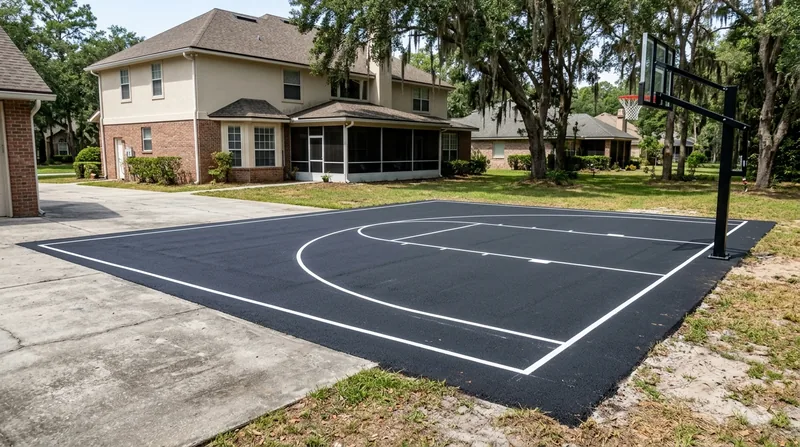




Sports Court & Path Paving in Jacksonville sits on the same sandy, wet foundation that challenges every driveway in the region. A basketball court or walking path on the Southside, in Mandarin, or near the beaches has to shed water fast, hold its base against seasonal settlement, and stand up to Florida heat without cracking or rutting. We compact the aggregate base in lifts, pitch the surface to drain away afternoon storms, and finish with hot mix asphalt suited to the climate. The difference between a court that holds for fifteen years and one that fails in five is in the base work and the pitch, not just the top layer. Read on to understand what makes a court or path work in Jacksonville's wet, flat terrain, and how to get it right the first time.
Why Sports Court & Path Paving Matters in Jacksonville's Climate
Jacksonville sits on pine flatwoods sand over a dense hardpan, with a high water table that stays wet even when the surface looks dry. That hardpan holds water instead of draining it, so any court or path that doesn't have proper pitch and a compacted base will settle unevenly after heavy rain. Summer afternoon storms and hurricane season push water across flat lots fast, and without good grading, that water pools under the surface and softens the base. A path or court built on sand alone, or laid directly onto hardpan, will break apart at the edges and develop alligator cracking within a year or two.
- We excavate and compact the aggregate base in lifts to prevent settlement into the wet sand below.
- We pitch the finished surface to shed water away from structures, courts, and low spots where it pools.
- We use hot mix asphalt formulated for Florida heat and humidity, not generic northern mixes.
- We proof roll the base to confirm it will not move under the weight of play or foot traffic.
These steps cost more upfront than laying asphalt straight onto sand, but they eliminate the settling and cracking that costs thousands to repair or replace.
Local example: A tennis court in Riverside or Avondale, where oak roots and old water lines complicate grading, needs proof rolling and compacted base lifts even more than a new court in Nocatee or St. Johns County. The terrain is the same wet sand and hardpan, but the obstacles make careless work visible fast.
For more on how we handle base preparation and drainage, see our page on gravel driveway installation and grading, which covers the same foundation principles.
Jacksonville's city permit office sets rules for work on public rights-of-way and drainage structures; verify with your city or county before breaking ground.
How We Build a Sports Court or Path That Holds in Jacksonville
We start with a site visit to check drainage, identify utilities, and measure the area. We mark out the court or path, check for low spots and standing water after rain, and plan the pitch to move water away from play areas. Florida 811 utility locates are required by law before any excavation, so we call them in and wait for the markings before we dig. Once utilities are clear, we remove the top layer of sand and soft material, then compact the base in lifts using a vibratory compactor to lock the aggregate together.
- We call Florida 811 for utility locates and wait for markings before any excavation begins.
- We remove unstable surface material and soft sand down to firm hardpan or stable subgrade.
- We place and compact aggregate base in four to six inch lifts to build a solid foundation.
- We proof roll the finished base with a heavy compactor to confirm it will not settle under load.
- We lay the asphalt binder course, then the finish course, with proper pitch to shed water.
- We compact each layer hot, while the asphalt is workable, to lock it tight and maximize density.
The whole process takes three to five days for a typical court, depending on size and weather. We do not open the surface to traffic until it has cooled and cured, usually the next morning.
Real example: A basketball court in Jacksonville Beach, 2,500 square feet, sits on a lot that drains poorly toward the south end. We excavated eighteen inches, compacted the base in six-inch lifts, and pitched the surface one inch per eight feet toward a drainage swale. The court has held for four years with no settling or cracking, because the water moves off it fast and the base doesn't stay wet.
See our asphalt driveway paving page for more detail on base preparation and compaction methods that apply to courts and paths as well.
Methods for Court and Path Paving in Jacksonville
| Approach | Description | Best for |
|---|---|---|
| Full-depth new court or path | Excavate soft sand and material, compact aggregate base in lifts, lay binder and finish courses with proper pitch. | New courts, paths on wet or poorly drained ground, or where existing surface is gone. |
| Overlay on existing court | Mill or scarify the old surface, add a new binder and finish course, re-pitch to ensure drainage. | Courts that are still structurally sound but worn, rutted, or have lost pitch over time. |
| Patch and repair | Cut out failed spots, repair the base if soft, and patch with new asphalt compacted to match surrounding surface. | Small cracks, potholes, or soft spots that have not spread across the whole court. |
| Grading and drainage retrofit | Regrade the court to improve pitch, compact base, and lay new finish course to shed water better. | Courts that pond water or settle in low spots, especially in older subdivisions or tight residential lots. |
Each method has a different cost and timeline. We recommend an on-site visit to assess the existing surface and base before deciding which approach will hold longest and cost least over the life of the court.
Sports Court and Path Paving Cost in Jacksonville: What to Expect
A new sports court or path paving project in Jacksonville starts at around $8,500 for a small court or a long walking path on stable ground with good drainage. The cost moves up with the size of the area, the condition of the base, the amount of excavation and grading needed, and whether utilities or obstacles complicate the work. A full-size basketball court, 4,700 square feet, typically runs $12,000 to $18,000 including base work and pitch. A tennis court or a half-court runs $6,000 to $10,000. A walking path, 300 to 500 feet long and eight feet wide, runs $4,500 to $7,000.
The biggest cost variables are base condition and grading. If the existing ground is stable hardpan with good drainage, the job costs less. If we have to excavate soft sand, compact multiple base lifts, and regrade to improve pitch, the cost goes up. Obstacles like tree roots, utility lines, or structures close to the court also add time and material.
We always recommend getting two or three estimates from contractors who will visit the site, measure it, and explain what base work is needed. A written estimate should include the thickness of the asphalt, the tonnage of aggregate and asphalt, the pitch or slope specification, and the timeline. Avoid any estimate that is a price per square foot with no detail on base work or thickness, because that is how corners get cut.
For a detailed look at pricing and what moves the cost for different paving projects, see our pricing page. Call us at (904) 569-5441 for a free on-site estimate with no obligation.
Sports Court and Path Paving Near Me: What Jacksonville Homeowners Should Know When Hiring a Contractor
Hiring the right contractor for a court or path is as important as the design itself. Start by asking any contractor whether they are fully insured, and ask for a certificate of insurance naming you as an additional insured. In Jacksonville and the surrounding counties, licensing and permit requirements vary, so verify with your city or county building department what permits are needed for your court or path and whether the contractor must hold a local license. Check the contractor's references, especially from jobs in your neighborhood where soil and drainage are similar. Ask for a written estimate that includes the thickness of the base and asphalt, the tonnage of material, the pitch specification, and the timeline.
- Verify that the contractor is fully insured and ask for a current certificate of insurance.
- Call your city or county building department to confirm what permits are needed for your court or path.
- Ask the contractor whether they will pull the permit or help you navigate the process with your local authority.
- Get a written estimate that specifies asphalt thickness, base material, tonnage, and drainage pitch.
- Check at least two references from recent jobs in Jacksonville or nearby, especially on similar soil and drainage.
- Avoid any contractor who offers to start work without a written contract, asks for a large cash deposit upfront, or claims they have leftover material from another job nearby.
A reputable contractor will be local, will have a verifiable address and phone number, and will be willing to explain why the base work matters and how the pitch will move water. If you have an HOA, check your architectural rules before you start, because some master-planned communities require approval of the court color, finish, or dimensions.
Ready to move forward? Contact us for a free estimate, or call (904) 569-5441 to discuss your court or path project.
Sports Court & Path Paving in Jacksonville: Pricing Guide
| Service | Price | Details |
|---|---|---|
| Small walking path or short court | Starting at $4,500 | 300 to 500 feet, eight feet wide, on stable ground with good existing drainage. |
| Basketball court or tennis court | Starting at $8,500 | Full-size court, 2,500 to 4,700 square feet, including base compaction and pitch. |
| Court with base repair or extensive grading | Starting at $12,000 | Excavation, soft base removal, multiple lift compaction, and drainage retrofit included. |
| Overlay on existing court | Starting at $6,000 | Mill, scarify, and lay new finish course with improved pitch on structurally sound base. |
| Travel and estimate | Included and free | No separate fee for travel in Jacksonville and surrounding areas; free estimate within 24 hours. |
Indicative pricing, the exact cost depends on square footage, finish, and site access. Free personalized estimate within 24h at (904) 569-5441.


