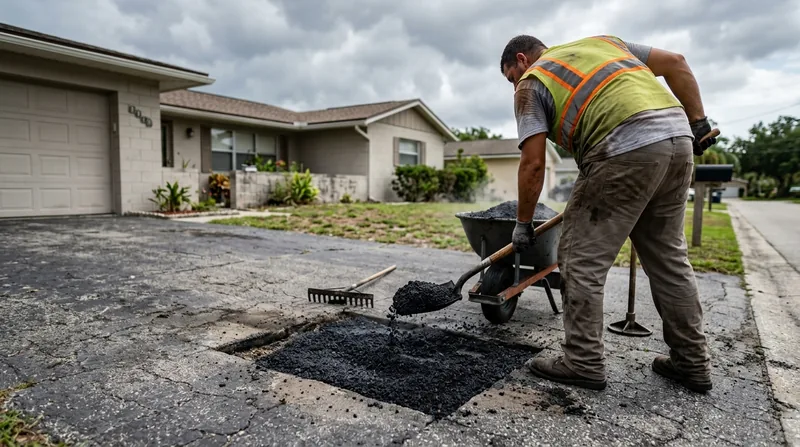




Jacksonville's flat terrain and high water table create ideal conditions for potholes. When afternoon downpours pond on low-lying driveways across neighborhoods from Riverside to Mandarin, water works into cracks and softens the base below. The result is a rapid collapse that opens into a pothole almost overnight. Pothole repair and asphalt patching stops this damage before it spreads, and the sooner you address it, the cheaper the fix stays. We cut back to solid asphalt, prep the edges, and patch with hot mix compacted to match the surrounding surface, so the repair holds tight through the next hurricane season and beyond.
Why Potholes Open Up Fast in Jacksonville: Terrain and Water
Jacksonville sits on pine flatwoods sand over a dense hardpan that sits a foot or two below the surface. This hardpan holds water even when the top looks dry, and the sand above it never compacts as well as clay or gravel does. When asphalt settles into that saturated base, edges break away and the center collapses under traffic. Summer afternoon storms dump three to four inches of rain in under an hour, and because the ground is already flat and wet, water ponds across driveways instead of running off. In older neighborhoods like Riverside, Avondale, and San Marco, oak roots lift asphalt slabs from below over decades, opening cracks that let water in. In the newer subdivisions across the Southside and St. Johns County, longer driveways over open ground settle unevenly where the base is wetter on one side.
- Water enters through small cracks and softens the sand base underneath.
- Traffic breaks away the weakened edges, creating a depression.
- Rain collects in the depression and spreads the damage outward.
- A pothole forms in days once the collapse starts.
The longer a pothole sits, the more it costs to fix. A small patch catches it at one price; a large pothole that has eaten into the base costs more and may signal that driveway repair or resurfacing is the better choice than patching alone.
Key info: A pothole in a Riverside driveway that started as a quarter-size depression in May can become a foot-wide crater by August if left untreated. The same damage in Atlantic Beach or Jacksonville Beach accelerates under the weight of seasonal traffic and salt air. Call early.
According to the Federal Highway Administration, pothole formation accelerates in regions with freeze-thaw cycles and high groundwater, and while Jacksonville does not freeze, the wet sand base and standing water create the same failure mode.
How We Patch Potholes: The Process in Jacksonville
A proper patch holds because we remove the failed asphalt and base back to solid ground, tack the edges, and fill with hot mix asphalt compacted to the same density as the original surface. This is not a fill-and-go job. If the base is soft, the patch will fail again in months. If the edges are not sealed, water will work back in. If the patch is not compacted correctly, it will rut under traffic. We measure the damage, quote the work, and explain whether a single patch makes sense or whether the driveway needs wider repair.
- We inspect the pothole and the asphalt around it to find the boundary of solid material.
- We cut back the failed asphalt and loose base to create clean, vertical edges.
- We inspect the base and repair any soft spots with compacted aggregate if needed.
- We tack the cut edges with a bonding agent so the new patch adheres.
- We place hot mix asphalt in lifts, compacting each layer to match the surrounding surface density.
- We finish the patch level and smooth so water runs off instead of pooling.
A typical pothole repair in Jacksonville takes two to four hours depending on size and base condition. If the pothole is part of a larger failure pattern, we may recommend asphalt resurfacing instead of patching, because throwing patches at a driveway with multiple failures wastes money.
Local example: A pothole opened in a Mandarin driveway in June after heavy rain settled the base around an oak root. We cut back eight square feet and patched with hot mix. The repair has held for three years because we removed the loose base and sealed the edges properly. The same driveway now has alligator cracking elsewhere, which means the next step is resurfacing, not more patches.
Pothole Repair Methods and When to Use Each
| Method | Description | Best for |
|---|---|---|
| Throw-and-Go | Cold mix asphalt dumped into a pothole without edge prep or base inspection. | Temporary fixes only; fails in months when the base is wet or loose. |
| Semi-Depth Patch | We remove the top two to three inches of failed asphalt and base, tack the cut, and fill with hot mix. | Shallow potholes where the base below is still solid and the damage is localized. |
| Full-Depth Patch | We cut back the entire asphalt section and inspect or repair the base, then fill with hot mix in compacted lifts. | Large or deep potholes, or when the base is soft and needs rework before patching. |
| Resurfacing Instead | We mill off the top layer and pave a new wearing course over the existing base if it is sound. | When potholes are multiple or scattered across the driveway, patching becomes uneconomical. |
We always inspect the full driveway before quoting. If potholes cover more than thirty to forty percent of the surface, or if they are clustered in a pattern that signals base failure, we tell you that resurfacing or replacement is the better investment.
Pothole Repair and Asphalt Patching Cost in Jacksonville: What to Expect
A single pothole patch in Jacksonville starts at $450 and moves up based on size, depth, and base condition. A pothole that is two feet across and four inches deep costs less than one that is four feet across and eight inches deep, because the larger job requires more material, more compaction, and more labor. If the base underneath is soft and needs rework before the patch can hold, the cost rises. If the pothole is in a tight corner near a foundation or tree, access costs more. We measure on site and give you a written estimate with tonnage and labor detail so you know what you are paying for.
Most Jacksonville homeowners pay between $450 and $1,200 for a single pothole patch. A driveway with multiple potholes scattered across it may cost $1,500 to $3,500 to patch, at which point resurfacing the entire driveway often makes more financial sense because you get a fresh surface and a warranty on the work. Always get two or three estimates so you can compare not just price but also the depth of the inspection and the detail of the quote. A vague estimate with no tonnage or compaction note is a red flag.
Travel to Jacksonville, Orange Park, Fleming Island, and the surrounding areas is included in our estimate. We respond to pothole quotes within 24 hours at (904) 569-5441. For a detailed breakdown of pricing across all our services, visit our full pricing page.
Pothole Repair and Asphalt Patching Near Me: What Jacksonville Homeowners Should Know When Hiring
The asphalt paving trade has a long history of door-to-door crews offering to patch potholes with "leftover material from a job nearby," usually for cash and no contract. These jobs fail because cold asphalt does not bond, bases are not inspected, and there is no recourse if the patch fails in weeks. When you call a paving contractor, verify that they are local, that they provide a written estimate with tonnage and compaction notes, and that they stand behind the work with a warranty. Ask for references from recent pothole repairs in your neighborhood. A local contractor with a local address and local plates is far less likely to disappear if something goes wrong.
- Check that the contractor is fully insured and ask for a certificate of insurance before work begins.
- Get a written estimate that includes the area of the patch, the depth, the tonnage of asphalt, and the compaction method.
- Ask whether the contractor will inspect the base and repair soft spots before patching, or if they skip that step to save time.
- Verify that your city or county requires a permit for the work and confirm the contractor understands local rules.
- Request references from similar jobs done in the past year in Jacksonville or nearby.
- Confirm the warranty on the patch work, typically one to three years on labor and materials.
We have been in business since 2013 and serve Jacksonville, Orange Park, Fleming Island, Fruit Cove, Nocatee, St. Augustine, Jacksonville Beach, Atlantic Beach, Neptune Beach, Yulee, Fernandina Beach, Middleburg, Green Cove Springs, Oakleaf Plantation, and World Golf Village. We provide written estimates with tonnage and compaction specs, and we stand behind every patch. If you are ready to get a pothole fixed, contact us for a free estimate.
Pothole Repair & Asphalt Patching in Jacksonville: Pricing Guide
| Service | Price | Details |
|---|---|---|
| Single pothole patch | Starting at $450 | Small to medium pothole, solid base, standard access, hot mix patch with compaction |
| Large or deep pothole | Starting at $800 | Pothole larger than three feet or deeper than six inches, base inspection and repair included |
| Multiple potholes or cluster repair | Starting at $1,500 | Three or more potholes on same driveway, often more economical as resurfacing than patching individually |
| Difficult access or soft base | On estimate | Pothole near trees, structures, or with compromised subgrade requires site inspection before pricing |
| Travel | Included | No mileage fee or travel charge for Jacksonville and surrounding service areas |
| Estimate | Free | Written estimate with tonnage and compaction specs, response within 24 hours at (904) 569-5441 |
Indicative pricing, the exact cost depends on square footage, finish, and site access. Free personalized estimate within 24h at (904) 569-5441.


